Catch-up bookkeeping
For you if the last reconciled month is somewhere in the past and you need a fixed price to make the whole history reliable again.

Hand your day-to-day books to a firm that owns the close: categorisation, reconciliation, payroll, collections, reporting, and a year-end file your tax accountant can work from without asking forty questions. Six services, all in QuickBooks Online or Xero, every close reviewed by an ACCA-qualified accountant before it reaches you.
Are your books up to date?
Do you sell online through Shopify, Amazon or Stripe?
Do you run payroll?
Which software are your books in?
Your shortlist
Most small businesses buy two or three of these, not six. Answer the questions and yours line up here, in the order we would do them.
Can wait until the file is clean: AP & AR, management reporting and the year-end pack.
Book a free books reviewA starting point, not a scope. The free review looks at your actual file.
Nobody outsources because a brochure convinced them. They outsource because one of these became impossible to ignore.
Weeks of transactions are sitting unreviewed and the password is in someone's leaving email.
Everyone enters things. Nobody signs a month off, so nothing is ever final.
Wages leave the bank as one lump. Tax, pension and net pay are guesses in your accounts.
Nobody is watching the ageing, so collections start the week payroll is due.
You spend a fortnight answering them and pay for the privilege of being asked.
The transactions are typed in. Nobody has ever told you what any of it means.
Take one or take all six. Every engagement is scoped in writing before work starts. A fixed monthly fee follows transaction volume and complexity, not hours logged. Hourly work is priced on the seniority of the person doing it.
On your shortlist
The base service. Every transaction coded, every account reconciled to a statement, and a closed set of accounts by the 10th.
On your shortlist
A one-off fixed-fee project. We rebuild the backlog month by month, fix miscoded history and clear whatever is in suspense.
On your shortlist
Pay runs prepared on schedule, payslips issued, deductions calculated, and the journals posted so payroll stops distorting your P&L.
On your shortlist
Bills entered, coded and scheduled for your approval. Invoices raised on time and chased on a written sequence rather than when someone remembers.
On your shortlist
Monthly accounts with written commentary: what moved, why it moved, and the two numbers worth watching next month.
On your shortlist
A documented pack your CPA, EA or chartered accountant can file from directly. We prepare the file. They file the return.
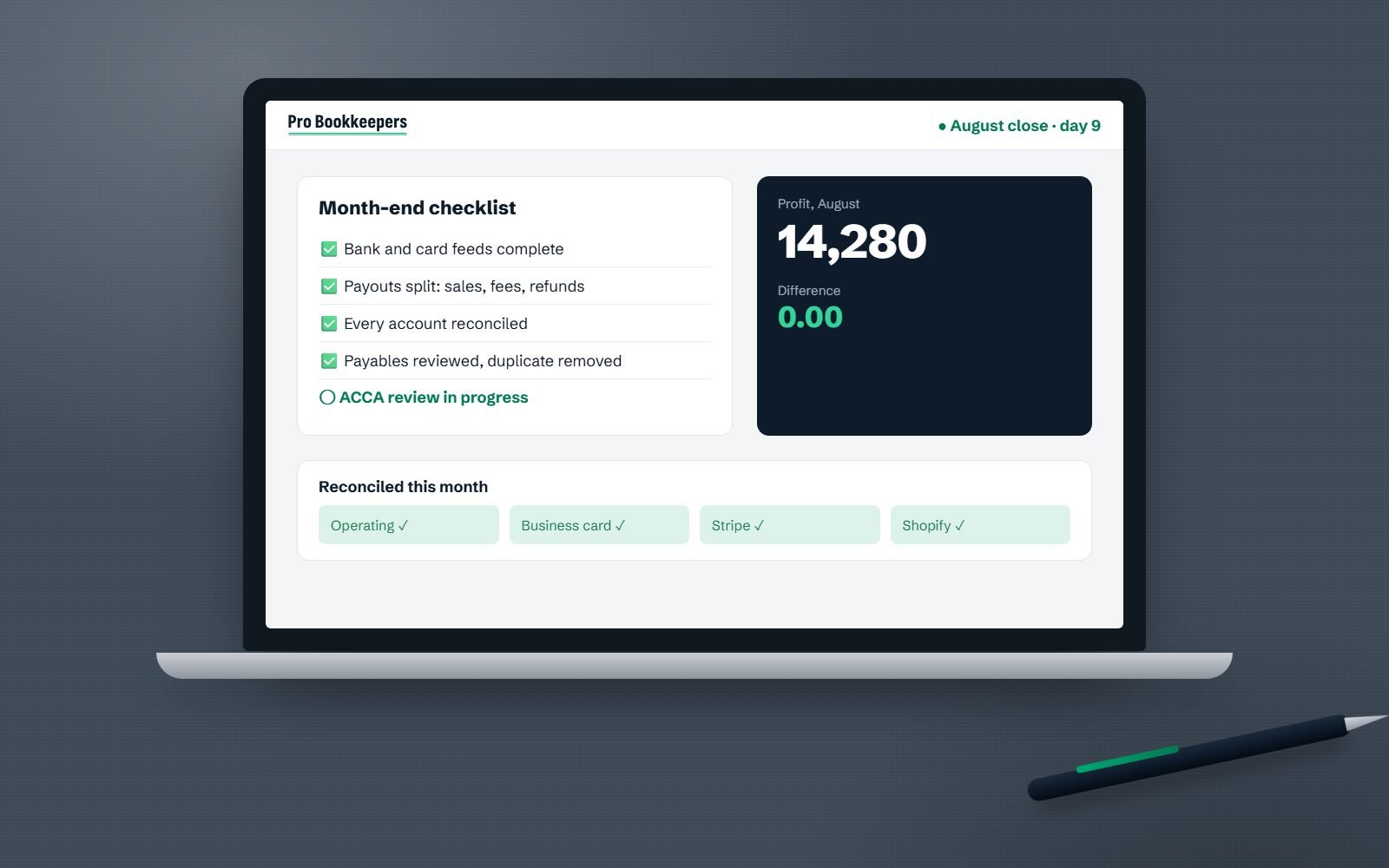
Feeds, payouts, reconciliations and payables are checked in the same order before the accountant’s review. Nothing is marked closed until every line is ticked.
These pages go into the detail the summary above skips: what the work involves, what it costs and where it commonly goes wrong.
For you if the last reconciled month is somewhere in the past and you need a fixed price to make the whole history reliable again.
For you if Shopify, Amazon or Stripe payouts land as single net deposits, which means your revenue, fees and refunds are all invisible.
For you if your books already live in QuickBooks Online and you want someone who works in it daily rather than learning it on your file.
For you if you run Xero and want the bank rules, tracking categories and repeating invoices set up so the file works the way Xero intends.
For you if pay runs happen but the journals, employer costs and payroll control account never quite reconcile at month-end.
For you if you want the numbers before the conversation: both models, all six tiers, and what sits inside each one.
There is no implementation project and no software migration unless you want one. Most clients are live within five working days.
Twenty minutes inside your current file. We check what is reconciled, what is sitting in suspense and which of the six services you genuinely need.
One page: the services included, the monthly fee, the catch-up fee if there is a backlog, what is explicitly out of scope, and the date of your first close.
Limited-access users in your own software, bank feeds authorised by you, a receipt inbox, and a chart of accounts agreed with your tax accountant.
Closed by the 10th, reports with commentary, and a short note naming anything that needs a decision from you before next month.
Most files that arrive here balance. That is not the same as being right. A ledger balances the moment every entry has a matching opposite entry, whether or not those entries describe anything that happened.
So we reconcile to statements rather than to bank feeds. Feeds silently drop transactions, duplicate them after a reconnection, and quietly stop for weeks without an error. A file reconciled to a feed can be missing transactions it never received and still show a green tick.
The other half of the work is the balance sheet, which is where errors hide for years. Every line gets a supporting schedule: what the balance consists of, and why it is that number and not another one.
Reviewed & closed
No. We work in QuickBooks Online and Xero every day and also run Sage, Wave, Zoho Books and FreshBooks. Your subscription stays in your name, and you keep the master login throughout.
We will suggest a move only when the current tool is the actual problem, and we will say which parts of the switch are genuinely painful. Historical data rarely migrates as cleanly as the vendor's marketing implies, and a badly timed migration can cost more than the software ever will.
Where we do push is on the surrounding tools. A receipt-capture app, a properly configured sales channel connector and a small set of bank rules remove more manual work than switching ledger ever would.
Two models. Fixed monthly when the work is predictable, hourly or a dedicated resource when it varies. Both agreed in writing before anything starts.
Priced on transaction volume and complexity, never on hours logged. Catch-up work is quoted separately as a one-off.
A named person working set hours inside your systems. Minimum 10 hours a month, hours logged and reported weekly.
Offshore bookkeeping only works if the access model is boring and reversible. Here is exactly what we ask for.
We never ask for your online banking login, and you should refuse any bookkeeper who does. Bank feeds are authorised by you, directly with your bank, and you can withdraw that authority yourself.
Your QuickBooks or Xero subscription stays in your name and we work inside it as limited users. Every action we take is stamped in the audit log, and removing our access takes you about ten seconds.
Payments and pay runs are prepared and scheduled for your release. We do not hold authority to move money out of your accounts, and we do not want it.
Still unsure which of the six you need? Run the service finder or book the free review.
Start from what is currently going wrong rather than from a menu. If you cannot say what last month made, you need monthly bookkeeping. If the last clean month was some time in the past, you need a catch-up first and monthly bookkeeping after it. If payroll runs but never lands correctly in the profit and loss, you need payroll plus the journals. If money is collected late or bills get paid twice, you need AP and AR. If the numbers are accurate but nobody explains them, you need management reporting. If your tax accountant bills hours to rebuild records every year, you need a year-end pack.
Most small businesses buy two or three of these, not six. On the free books review we look at your actual file and tell you which ones move the needle and which ones you can skip for now. We would rather scope a smaller engagement that works than a bigger one that stalls.
Yes, and most clients do. The usual path is monthly bookkeeping first, because everything else depends on the ledger being right. Payroll journals, AP and AR ageing, management commentary and the year-end pack are all built on top of a reconciled file, so adding them before the base is clean produces confident-looking reports built on bad data.
Once one or two closes have run cleanly, adding a service is a scope change rather than a new onboarding: the access, the chart of accounts and the document flow already exist. We reprice in writing before anything changes, and there is no penalty for adding or dropping a service. On a fixed monthly plan, adding a service usually moves you up a tier instead of creating a second invoice. On hourly or a dedicated resource, it simply changes what those hours are spent on.
We do not. Every quote follows a look at the actual file, because the two things that drive the work are transaction volume and how much of the history is wrong, and neither is visible from a conversation.
On the free books review we ask for read-only access or a screen share and check a short list: how many bank, card and payment accounts exist, when each was last reconciled to a statement, what is sitting in suspense or uncategorised, whether the balance sheet holds balances nobody can explain, and whether payroll and sales platforms post correctly. That takes about twenty minutes.
You then get a one-page proposal with the monthly fee, the catch-up fee if there is a backlog, what is in scope, what is not, and the date your first close lands. If the file is in better shape than you feared, the quote says so.
The bookkeeper does the work and the accountant decides whether the work is right. A bookkeeper categorises transactions, reconciles accounts to statements, chases documents, enters bills, raises invoices and prepares the month for closing.
An ACCA-qualified accountant reviews that close before it leaves the firm: whether the balance sheet is supported by schedules, whether accruals and prepayments have been treated consistently, whether a margin movement is real or a coding error, and whether anything in the numbers needs flagging to you.
In practical terms this is why an error gets caught in month one rather than at year-end, when it is eleven months more expensive to fix. It is also why a bookkeeper is priced at $14 an hour here and an ACCA accountant at $28. In the second case you are paying for judgement, not keystrokes. The mistakes that cost the most are almost never data-entry errors.
Only if the opening balances cannot be trusted, which is the case more often than owners expect. Monthly bookkeeping starts from a known position: the prior month closed, reconciled and supported. If the last reconciled month was eight months ago, starting monthly work now produces a current month that balances on top of an unreliable base, and the problem just moves down the page.
So we check first. If the gap is a few weeks of unreconciled feeds, it gets folded into the first close at no extra cost. If it is months or years, or the history carries miscoded entries and a growing suspense account, we quote a separate fixed-fee catch-up, run it month by month, and move you onto the normal monthly rhythm once the file is current.
The catch-up is always priced as a one-off so you can see exactly what the backlog costs, separately from your ongoing fee. Our guide to catching up 12 months sets out the order we work in.
They work alongside them, deliberately. We do not file tax returns and we do not audit. What we produce is the input your tax professional needs: a closed ledger, reconciled control accounts, supporting schedules for the balance sheet, fixed asset and depreciation workings, and a year-end pack they can file from without rebuilding anything.
Most tax accountants are glad to receive it, because a large share of what they bill at year-end is reconstruction work rather than tax work. We are happy to speak to yours during onboarding to agree the chart of accounts, the treatment of anything unusual, and the format they want the year-end pack in.
If you do not have a tax professional yet, we will tell you what to look for in your jurisdiction. We will not pretend we can do the filing ourselves.
Fixed monthly suits work that looks the same every month: a steady transaction volume, a settled chart of accounts and a predictable close. You get a known number, we absorb the variance, and neither side watches a clock. Monthly bookkeeping, payroll and reporting usually fit this model well.
Hourly or a dedicated resource suits work that varies, work with an end date, or work that has to happen inside your systems on your schedule. Catch-up projects, seasonal spikes, AP and AR during a cash crunch, and businesses that want a named person on set hours all fit better hourly. Rates are $14 an hour for a bookkeeper, $20 for a senior bookkeeper and $28 for an ACCA accountant, with full-time equivalents of $1,650, $2,400 and $3,600 a month.
We will tell you which is cheaper for your situation even when it is the smaller number. The full pricing page sets both models out side by side.
Tax return preparation and filing, in any country. Statutory payroll filing, which stays with your local agent or bureau. Statutory audit or assurance work. Company formation and registered agent services. Personal financial or investment advice. Signing anything on your behalf, or moving money out of your accounts: we prepare and schedule payments, and you approve and release them.
We are also not a software vendor, so your QuickBooks Online or Xero subscription stays in your name and under your control.
Within bookkeeping itself, scope is written down in the proposal rather than left to assumption: the number of accounts, the transaction band, which entities are covered, and how many payroll employees are included. Anything outside that is quoted before it is done, never invoiced afterwards as a surprise. If a request falls outside what we do well, we say so and point you at someone who does it, which is cheaper for both of us than learning on your file.
The order to rebuild a backlog in, what to do when bank feeds only reach back 90 days, and how to tell when the job is genuinely finished.
The checklist we work through before any set of accounts is signed off. It works whether you outsource the close or run it in-house.
Where each genuinely wins, where each quietly frustrates, and which one to pick before you commit your history to it.
The errors we find most often when a new file arrives, why each one survives for years, and what it costs to leave in place.
Twenty minutes inside your current file, a plain reading of what is broken, and a fixed number to fix it. If you only need one service, we will scope one service.