A diagnostic on the existing file
Before a quote exists we count the unreconciled months, the accounts involved and the transactions sitting uncoded, then tell you whether the file can be repaired or has to be rebuilt.

Catch-up bookkeeping is the work of rebuilding every unrecorded month until each account reconciles and the balance sheet can be proven line by line. We do that for you: oldest month first, statements sourced where the bank feed no longer reaches, and an ACCA-qualified accountant signing off the closing position before it goes to your tax professional.
| Statement | Opening | Closing | Chain |
|---|---|---|---|
| January | 12,400.00 | 9,870.35 | Proven start |
| February | 9,870.35 | 11,204.10 | Agrees |
| March | – | – | No statement |
| April | 8,915.60 | 10,332.45 | Break |
April opens at 8,915.60, not 11,204.10. March is missing, so we request it.
Any one of these means the file has stopped being a record and started being a guess.
The same email about last year's figures keeps arriving, and you keep not having an answer that is true.
Somewhere behind you a bookkeeper left, or a busy quarter happened, and nobody has closed a month since.
Everything older was never imported, so the file looks finished while most of the year is simply absent.
Or in ask-my-accountant, which is the same account wearing a politer name. Nobody has opened it in a year.
The figure the software carried forward cannot be traced to a statement, a prior return or any schedule that exists.
The filing date is fixed, the numbers are not, and the plan is currently hope.
If any of these is true, the free review tells you whether the file can be repaired or has to be rebuilt.
Book a free books reviewSet the months since your last genuinely reconciled month. You get the published price band, the typical timeline, and what moves a project inside its band. Your fixed fee is agreed in writing after the free diagnostic.
Nothing you enter here is sent anywhere.
Published price band
$900 – $1,800
4 to 6 months behind
Typical timeline
Two to three weeks
Six months is normally finished in two to three weeks, where a usable file and complete statements already exist.
Rebuilt oldest month first ·
What moves you within the band
A guide, not a quote. Bands are the ones published below and on our pricing page. The fee is fixed in writing after the free diagnostic.
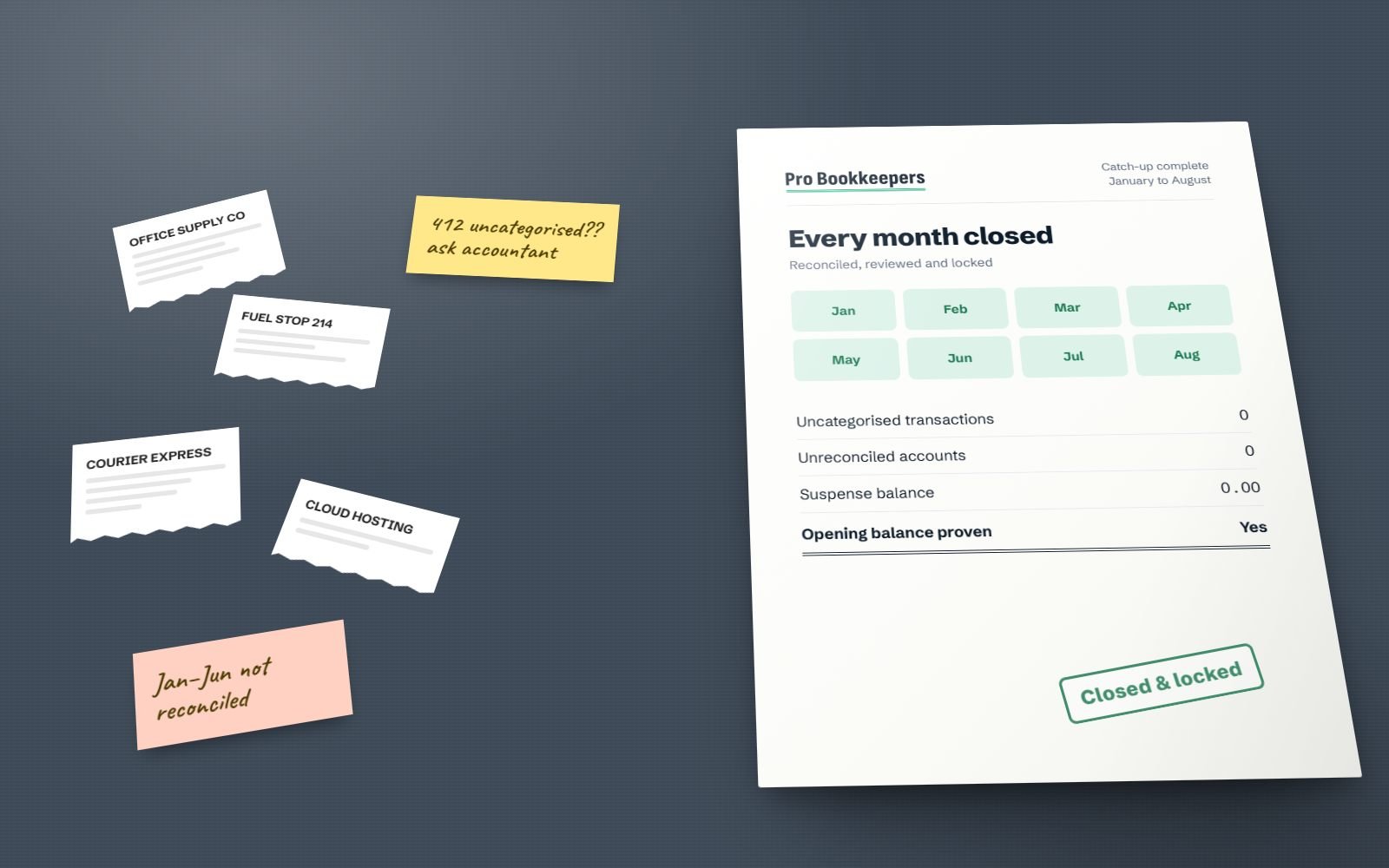
Oldest month first, every account reconciled to a statement, the opening balance proven and the finished periods locked, so the work cannot quietly come undone.
Six deliverables, all of them things you can check.
Before a quote exists we count the unreconciled months, the accounts involved and the transactions sitting uncoded, then tell you whether the file can be repaired or has to be rebuilt.
Where the bank feed stops, we go to online banking exports, archived statement libraries and direct bank requests until every month of every account has a statement behind it.
Oldest month first, each one categorised, reconciled and closed before the next begins. A month reconciled against an unproven starting figure has proved nothing.
Every balance sheet figure carried into the rebuild is traced to a statement, a prior-year pack or a schedule. Where it cannot be traced, you are told, in writing.
Every item in suspense and uncategorised is traced to source and coded properly, or listed as genuinely unidentifiable with its date and amount still visible.
Closed periods locked so the work cannot be edited by accident, plus the trial balance, reconciliations and schedules your accountant needs to file from.
Connect a bank feed today and the software imports whatever your bank is willing to hand the aggregator. For a large share of banks that is 90 days. For some it is 12 or 24 months. For almost none is it four years. Everything older never arrives, and nothing in the interface tells you it is absent.
That is how a file ends up looking finished while most of a year is missing. Matching bank-feed lines confirms that each imported transaction exists. It says nothing about months that were never imported, and those months are usually never reconciled to a statement at all, so the gap stays hidden.
So we source the history manually, cheapest route first: the CSV and PDF export inside your own online banking, then the archived statement library most banks hold for several years, then a written statement request, which can take days and sometimes carries a bank fee. The bank charges that fee to you as the account holder, not through us, and we tell you before making any request that would trigger one. Card issuers, loan providers and merchant platforms get the same treatment.
Then we prove the set is complete, which is the step almost everyone skips. A missing statement is invisible unless you go looking for it directly.
Export every statement your online banking will give you today. Access only gets harder: accounts close, cards get replaced, providers purge old data.
A rebuild starts from a position. If that position is wrong, every month after it is wrong by the same amount, and the file will still reconcile beautifully. This is the most common reason a second bookkeeper ends up redoing a first bookkeeper's catch-up.
So before the first month is touched, each balance sheet figure at the start date is traced to evidence: a statement, a lender schedule, an invoice list, a prior-year pack. A figure that cannot be traced does not get quietly accepted. It gets written down as unproven, with the amount, so you and your accountant can decide what to do about it.
The suspense account gets the same discipline. A suspense balance is not a mystery, it is a list of specific transactions somebody could not code at the time. Each one is traced back to a payment, a deposit or a document and put where it belongs. What genuinely cannot be identified stays visible with its date and amount, because a plug entry that makes a difference disappear also makes it impossible to ever find.
When a month is signed off, we lock it. Locked periods stop a well-meaning edit in February from silently changing a number your accountant filed from in January.
The order matters more than the speed. Rebuilding out of sequence is why second attempts exist.
We look inside the file, establish the last genuinely reconciled month and list what is missing. Twenty minutes on a call, then the review itself. No charge, no obligation.
One page: what gets rebuilt, what it costs as a single fixed fee, what we need from you, and the date the finished file lands. You approve before anything is touched.
Statements gathered, opening balance proven, then each month categorised, reconciled and closed in sequence. You get a short progress note as each quarter completes.
Trial balance, reconciliations and schedules delivered, closed periods locked, open questions listed, and a direct conversation with your accountant if you want one.
Quoted as one fixed fee for the whole backlog by default, after the diagnostic and separate from any monthly plan. If you already retain a dedicated bookkeeper by the hour, the catch-up can run inside those hours instead. These are the price bands we quote against.
$300 – $900
A recent slip. Usually one or two accounts, a straightforward rebuild, and the file is current again within a week of the statements arriving.
$900 – $1,800
Feed history has normally started to expire, so statement sourcing becomes part of the job, and there is usually coding to correct as well as to enter.
$1,800 – $3,500
A full year to rebuild, an opening balance that has to be proven properly, and typically a year-end sitting somewhere inside the period.
Quoted after review
Multi-year backlogs vary too much to band honestly. We look at the file first, then give you one number and one completion date.
What moves a project inside its band is transaction volume, how many bank, card and loan accounts need reconciling, whether the existing file can be repaired, and whether e-commerce payouts or payroll are involved. Once you are current, ongoing bookkeeping runs on a fixed monthly plan from $199 a month, or hourly from $14 for a bookkeeper up to $28 for an ACCA accountant.
Would rather do it yourself? That is a legitimate choice, and we have written the method out in full, in order, with the traps marked: how to catch up 12 months of bookkeeping. This page is for the version where somebody else does it and you get a completion date.
A catch-up needs more history than ordinary bookkeeping. It still does not need your banking logins.
We ask for exported statements, not credentials, and you should refuse any bookkeeper who asks otherwise. Bank feeds are authorised by you, directly with your bank.
We work through our own accountant or adviser user in your file, never your master login. You own the subscription, every entry is attributed in the audit log, and you can remove us in one click.
Full export the moment you ask, no exit fee and no notice games. If you move on, we talk to whoever takes over so the handover does not become the next backlog.
Something here wrong for your situation? Ask on the free review and we will answer for your file, not in general.
Ask us directlyIt depends far less on how many months you are behind than on how quickly the source material arrives. Where a usable file and complete statements already exist, one to three months is normally finished within a week, six months in two to three weeks, and a full year in three to five weeks. Multi-year and multi-entity rebuilds are longer and we give you a date rather than a range.
The bottleneck is almost never data entry. It is waiting on bank statements the feed no longer reaches, because some banks post archived statements by mail or take several working days to release them. That is why the first thing we ask you to do, on day one, is export every statement your online banking will give you. Your proposal carries a completion date, not a vague estimate, and if something changes that date we tell you the week it happens rather than the week it is due.
Catch-up is quoted as a one-off fixed fee by default, separate from any monthly plan. If you already retain a dedicated bookkeeper by the hour, the catch-up can run inside those hours instead. As a guide, one to three months behind runs $300 to $900, four to six months runs $900 to $1,800, and seven to twelve months runs $1,800 to $3,500. More than twelve months is quoted after we have looked at the file, because the range at that point is too wide to be honest about.
What moves the number inside a band is transaction volume, how many bank, card and loan accounts have to be reconciled, whether an existing file can be repaired or has to be rebuilt, and whether e-commerce payouts or payroll are involved. Sales that arrive as net Stripe or Shopify deposits take real work to unpick into gross revenue, platform fees and refunds. We quote after the review, in writing. The fee covers everything in the written scope. If we find more work inside that scope than expected, that is our problem. If something outside it turns up, such as an account nobody mentioned, we quote it separately before touching it.
You almost certainly have more than you think. Bank and credit card statements are the spine of a rebuild. Most transactions that mattered passed through one of them, so statements get you most of the way to a reconciled set of books. Cash takings and anything paid from personal accounts need a separate conversation, and we will ask about them.
Missing receipts are a different problem: they do not stop the rebuild, they affect what your tax professional is willing to claim. We record those transactions from the bank data, flag them on a schedule of unsupported items, and hand that schedule to your accountant so the decision sits with the person who files. Where there is an e-commerce or payment platform involved, the merchant reports from Stripe, PayPal, Shopify or Amazon usually reach back further than you expect and fill in the detail the bank deposit hides. If a genuine gap exists, we tell you exactly which period and which account it affects rather than quietly plugging it.
Whether being behind creates any exposure depends on your country, your entity type and what has or has not been filed. That is a question for your CPA, EA or chartered accountant, not for us. We do not file returns, we do not advise on penalties, and we will not guess at your exposure.
What we can do is the part that is blocking everyone: get the numbers finished quickly and accurately so your tax professional can assess the position with real figures instead of estimates. Finishing the books does not stop penalties by itself; filing the return and paying the tax does. But filing cannot happen without finished books, so this is the step that unblocks everything else. If you do not have a tax professional yet, tell us which country and state or region you file in and we will tell you what kind of practitioner you need, then hand over a pack they can work from directly.
Yes. We would rather work alongside your accountant than around them. Your accountant is usually the person who told you the books were unusable in the first place, so they have a clear view of what the finished file needs to contain. We ask them for their preferred chart of accounts, their depreciation policy, the format they want year-end schedules in, and whether any of the periods we are rebuilding have already been filed.
That last question matters: where a prior period has been reported to a tax authority, we do not silently restate it. We flag the correction, quantify it, and let your accountant decide how it should be handled. They keep the client relationship and the filing work. We keep the bookkeeping. The arrangement works because we are not competing for the same fee, and because a clean file makes their job cheaper for you rather than more expensive.
This is the single most common thing that stalls a catch-up, and it catches people out because the software gives no warning. When you connect a bank feed, the aggregator pulls only what the bank exposes, which is frequently 90 days and rarely more than 24 months. Anything older simply never arrives, and the file looks complete because nothing is missing from what was imported.
We work around it in the order that costs you least: first the CSV and PDF export inside your own online banking, which usually reaches back further than the feed does, then the archived statement library most banks keep for several years, then a direct statement request to the bank, which can take days and sometimes carries a fee charged to you by the bank, which we flag before the request goes in. Card issuers and loan providers are handled the same way. We then prove the set is complete, because a missing statement is invisible unless you look for it: the closing balance on every statement must equal the opening balance on the next one, month after month, with no gaps.
Usually not. We work inside your existing QuickBooks Online or Xero file wherever it can be repaired, because a new file throws away history, audit trail and every reconciliation that was actually done correctly.
Starting fresh is justified in a small number of situations: the opening balances in the current file cannot be substantiated by anything, the chart of accounts has been extended past the point of usefulness, two businesses have been recorded in one file, or the subscription has lapsed so far that the data is no longer accessible. If we think a new file is the right call we show you the specific reason before anything is touched, and we migrate the closed prior-year position as a proven opening balance rather than as a guess. We also work in Sage, Wave, Zoho Books and FreshBooks. If your books live somewhere we do not know well, we will say so rather than learn on your time.
We correct it rather than build on top of it, which is the difference between a clean-up and a tidier version of the same problem. The recurring findings are predictable: hundreds of transactions parked in one uncategorised or ask-my-accountant account, duplicate entries created when a bank feed was disconnected and reconnected, owner drawings sitting in cost of sales, e-commerce income recorded net of platform fees in some months and gross in others, and bank accounts marked as reconciled with a manual adjustment holding the difference.
Each of those is traced back to source rather than netted off. Where a correction lands in a period that has already been filed, it stops with a note to your accountant instead of being posted. You get a written list of everything we changed and why, which also serves as the answer to the question your accountant will inevitably ask about why last year no longer matches.
No. We do not file tax returns and we do not audit, in any of the countries we work in, and we would rather say that plainly at the start than at the end.
What you get instead is a file your tax professional can file from without rebuilding anything: a trial balance for each period, every bank, card and loan account reconciled to a statement, supporting schedules for the balance sheet, a fixed asset register with depreciation posted, and a clearly labelled list of the items we could not resolve without your input. A clean file usually costs less to file from, because your accountant no longer bills hours to rebuild records before the real work starts. If you do not have a practitioner yet, we will tell you what to look for in your jurisdiction, and we will speak to them directly during the handover.
Two sensible endings, and we are happy with either. The first is that we keep the file on a monthly schedule, closed by the 10th of each month, starting from the month after the backlog ends. Fixed monthly plans run from $199 a month, and catch-up clients move onto them at the same rate as anyone else because the backlog was already paid for.
The second is that you take the file back and run it yourself, which is a perfectly reasonable choice once someone has put it in order. In that case we lock every period we closed so the work cannot be accidentally edited, hand over the reconciliations and the document folder, and give you the month-end checklist we use internally. What we will not do is hand back a clean file and stay quiet about why it went wrong. Backlogs come back if nothing about the process changes, and the change is usually smaller than people expect.
A catch-up is a project with an end date. Once the backlog is closed, these are the natural next services.
Twenty minutes and a look inside your file. You get the number of months genuinely outstanding, what is wrong with what already exists, one fixed fee and one completion date. If the job is smaller than you feared, we will tell you that too.